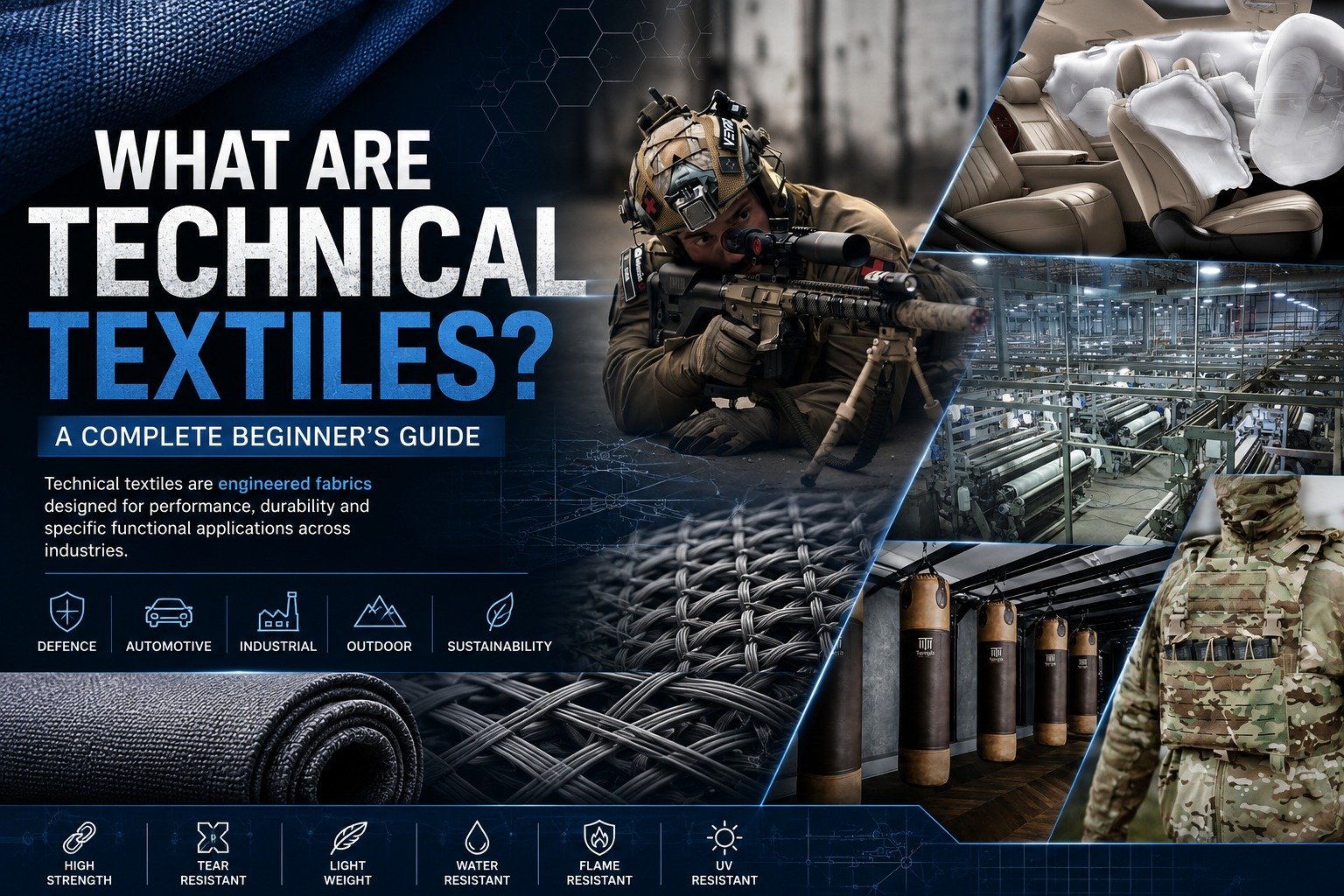
These are technical textiles — engineered fabrics designed to perform, not just to look good. And they are powering some of the most demanding industries on the planet.
What Are Technical Textiles?
Technical textiles are fabrics manufactured primarily for their functional performance rather than their aesthetic or decorative value. Unlike conventional textiles made for fashion or home furnishings, technical textiles are engineered to meet specific mechanical, thermal, chemical, or biological requirements.
They are produced from high-performance fibres such as Nylon 6, High Tenacity Nylon 6, High Tenacity Polyester, and Polyester Taffeta — each selected for precise characteristics including tensile strength, tear resistance, weight, and environmental durability.
In simple terms: if a fabric is doing a functional job beyond looking good, it is almost certainly a technical textile.
Why Are Technical Textiles Important in 2025?
The global technical textiles market is growing at an accelerating pace. Key drivers include:
- Rising defence spending driving demand for ballistic protection, parachute fabrics, and camouflage materials
- Make in India and NTTM pushing domestic manufacturers to reduce import dependency
- Infrastructure and industrial boom fuelling need for conveyor belts, safety gear, and geotextiles
- Healthcare expansion increasing demand for surgical drapes and medtech fabrics
- Sustainability mandates favouring OEKO-TEX certified and GRS-certified responsible manufacturing
- Sports and outdoor industry growth requiring high-performance rainwear, windbreakers, tents, and tactical equipment
Major Categories of Technical Textiles
Technical textiles are classified into 12 functional categories. The most relevant for industrial and defence applications include:
| Category | Key Applications |
|---|---|
| Protech | Ballistic protection, high-visibility safety gear, flame-retardant apparel |
| Indutech | Conveyor belts, industrial belts in chain stitch weave, filter fabrics |
| Medtech | Surgical drapes, wound care, sterile barrier textiles |
| Sporttech | Punching bag fabrics, tent linings, sleeping bag shells, rainwear, windbreakers |
| Mobiltech | Car airbags, seatbelt webbing, tyre cords |
Protech — Protective Textiles
Fabrics engineered for personal and structural protection. Includes ballistic protection materials, flame-retardant workwear, and high-visibility fluorescent safety gear for construction and industrial workers.
Indutech — Industrial Textiles
High-strength fabrics for manufacturing environments. Examples include conveyor belts and industrial belts in chain stitch weave requiring tensile strength, heat resistance, and dimensional stability.
Medtech — Medical Textiles
Surgical drapes are a key application — sterile, fluid-resistant barriers used in operating theatres to reduce infection risk.
Sporttech — Sports and Outdoor Textiles
Performance fabrics for active and outdoor use. Includes punching bag fabrics, tent linings, sleeping bag shells, rainwear, and windbreakers engineered for weight efficiency, weatherproofing, and repeated stress.
Mobiltech — Mobility Textiles
Car airbags are a prime Mobiltech example — made from high-tenacity nylon fabric that must deploy in milliseconds without tearing.
Key Raw Materials in Technical Textiles
Performance begins with the right fibre. Here are the four core materials used at Laxmipati Technical Textiles:
Nylon 6
Nylon 6 is a versatile, high-strength synthetic fibre with excellent abrasion resistance and flexibility. Used in industrial belts, lightweight jackets, tactical gear, and general-purpose technical applications.
High Tenacity Nylon 6
High Tenacity Nylon 6 is engineered with significantly higher tensile strength than standard Nylon 6. The preferred choice for defence textiles, parachute fabrics, and ballistic protection where standard nylon would fail under load.
Polyester Taffeta
Polyester Taffeta is a lightweight, tightly woven polyester with excellent dimensional stability and weather resistance. Widely used in sleeping bag shells, tent linings, rainwear, and windbreakers.
High Tenacity Polyester
High Tenacity Polyester is engineered for high strength-to-weight performance. Used in conveyor belts, car airbags, industrial reinforcement, and heavy-duty outdoor equipment.
How Are Technical Textiles Manufactured?
Technical textile production differs fundamentally from conventional fabric manufacturing. The process involves three core stages:
1. Precision Weaving
High-performance looms produce specific weave constructions — plain, twill, chain stitch, or leno — to achieve the required strength, porosity, and structural integrity for each end use.
2. Functional Finishing
Fabrics undergo dyeing, coating, or chemical treatment to impart specific properties: water repellence, UV stability, flame retardancy, or anti-microbial resistance.
3. Quality Testing
Each production batch is tested for tensile strength, tear resistance, colour fastness, and dimensional stability before dispatch.
At Laxmipati Technical Textiles, our two integrated facilities — a Weaving & Garmenting Unit and Processing & Knits Processing Unit — handle the complete manufacturing chain, backed by four decades of engineering expertise.
What Certifications Matter When Sourcing Technical Textiles?
When evaluating a technical textile supplier, certifications are proof of audited processes — not just marketing claims. Look for:
- ISO 9001:2015 — Quality management systems
- ISO 45001 — Occupational health and safety
- OEKO-TEX Standard 100 — Tested safe for human contact; no harmful substances
- GRS (Global Recycled Standard) — Verified recycled fibre content
- GOTS — Organic fibre with responsible processing
- WRAP and Sedex — Ethical manufacturing and social compliance
- Higg Index — Environmental and social performance benchmarking
View Laxmipati's full certifications on our About page.
Technical Textiles in India: The Opportunity Ahead
India has historically depended on imports for a large share of its technical textiles requirement. That is changing fast. The National Technical Textiles Mission (NTTM) — backed by a ₹1,480 crore government allocation — and PLI (Production Linked Incentive) schemes are accelerating domestic manufacturing capability across defence, medical, and industrial segments.
Surat, Gujarat, India's established textile hub, is emerging as a key centre for technical textile production. Laxmipati Technical Textiles, headquartered in Pandesara, Surat, has been engineering high-performance fabrics for defence, industrial, sports, and medical applications since 1984 — supplying domestic and export markets.
Frequently Asked Questions
What is the difference between technical textiles and regular textiles?
Regular textiles are designed primarily for appearance — how they look and feel. Technical textiles are designed for function — how they perform under specific mechanical, thermal, or chemical conditions. A parachute fabric and a dress fabric are both woven, but they serve entirely different purposes.
Which industries use technical textiles the most?
Defence and military, automotive, healthcare, industrial manufacturing, agriculture, construction, and sports and outdoor are the largest global consumers. In India, defence and industrial applications are the fastest-growing segments.
Are technical textiles more expensive than regular fabrics?
They typically cost more than commodity fabrics, but the premium reflects higher performance, longer service life, and the critical roles they serve. In applications like car airbags or ballistic protection, performance reliability is not negotiable.
Can technical textiles be sustainably manufactured?
Yes. With GRS-certified recycled fibres, renewable energy-powered manufacturing, and responsible finishing practices, technical textiles can meet high sustainability standards. Laxmipati Technical Textiles operates on 10.6 MW of solar and wind renewable energy and holds OEKO-TEX, GRS, and GOTS certifications.
Where are technical textiles manufactured in India?
Gujarat (especially Surat), Maharashtra, Tamil Nadu, and Telangana are the primary manufacturing centres. Surat has a particularly strong base in high-performance woven technical fabrics for defence and industrial use.
How do I choose the right technical textile for my application?
The right fabric depends on your end-use performance requirements — tensile strength, weight, chemical resistance, weather exposure, and regulatory standards. Contact Laxmipati's technical team to discuss material specifications for your specific application via our contact page.
Conclusion
Technical textiles are the invisible infrastructure of modern industry. They protect, reinforce, filter, and enable performance across dozens of critical applications — from the parachute that opens at altitude to the surgical drape in an operating room. As India scales its manufacturing ambitions and global demand for high-performance fabrics grows, technical textiles represent one of the most significant opportunities in the country's industrial future.
About Laxmipati Technical Textiles
The industrial division of the Laxmipati Group, engineering high-performance fabrics for critical applications since 1984. Two integrated production facilities in Surat, Gujarat. Certified to ISO 9001:2015, ISO 45001, OEKO-TEX Standard 100, GRS, GOTS, WRAP, Sedex, and Higg Index standards.